Posted By: Nikki Wilson
1st April 2026
4 minute read


Guest blog by Alliance member Victoria White, founder of Neurodivergent Birth CIC, to mark Autism Awareness Day 2026.
On World Autism Day 2026, we explore why neurodivergent traits are often misunderstood in perinatal care, and what a simple but powerful reframe could mean for families.
Imagine walking into a midwife appointment already exhausted from masking your true self and from spending every social interaction translating yourself into a version other people find acceptable. You sit down and answer questions carefully, precisely and honestly. And somewhere in the notes, someone writes: “flat affect”, which refers to someone showing minimal emotional expression, a lack of eye contact and potentially speaking in monotone.
This observation, made without context and without any consideration of neurodivergence, can set off a chain of events that is difficult to reverse, including increased scrutiny, negative assumptions about capability, and in some cases, a social services referral. These are flags that then follow you through the system, however they may not accurately reflect risk, but simply neurological difference.
This is the reality for many autistic and neurodivergent people navigating pregnancy, birth, and the postnatal period. And on World Autism Day 2026, we want to name this issue clearly: pathologising neurodivergent behaviour can cause harm, and it is time for that to change.
Neurodivergent traits are frequently misread as red flags in perinatal settings. Communication differences including direct speech, difficulty with small talk and unconventional eye contact, can be misinterpreted as disengagement or hostility. Executive functioning challenges, which might affect things like keeping appointments, completing paperwork, or maintaining a tidy home environment, can be read as neglect or incapacity. Smaller social networks, which are extremely common among autistic people, can raise alarm about isolation. Unconventional but loving parenting styles can prompt questions about bonding.
None of these things are, in themselves, indicators of safeguarding risk. But in a system that has been designed around neurotypical norms of communication and behaviour, they can trigger that response.
The consequences are serious, including potentially unnecessary referrals and the stress of increased monitoring during an already vulnerable period. Neurodivergent people may experience the trauma of feeling watched rather than supported. And for some families, there will be involvement from statutory services that should never have been initiated. The research is unambiguous that stress and anxiety during the perinatal period can have lasting effects on maternal mental health. When that stress is caused by the very services designed to support us, it causes measurable harm.
There is a concept in autism research called the double empathy problem, first described by researcher Damian Milton in 2012. For decades, the dominant narrative in autism research and clinical practice was that autistic people struggle to understand others and that the communication difficulty was located entirely within the autistic person. Milton challenged this assumption and argued that when autistic and non-autistic people misunderstand each other, the difficulty is mutual. Both sides are failing to fully read the other. However, only one side has been pathologised for it.
This principle applies in perinatal care. When a neurodivergent parent is misread, misunderstood, or misjudged, that outcome is not simply a product of their neurodivergence. It is a product of the interaction, and every midwife, health visitor, obstetrician, and perinatal mental health professional is part of that interaction.
Neurodivergent Birth CIC (ND Birth), an organisation supporting neurodivergent families through pregnancy and beyond, has developed a campaign that offers a reframe. ‘Think Neurodivergence First’ asks perinatal professionals to pause and ask one question: could this behaviour or way of being reflect an unmet need, a sensory sensitivity, or a communication difference, rather than a cause for concern?
This is not a framework for ignoring genuine risk nor is it about removing professional judgement or treating every difference as automatically fine. There will always be situations where concern is warranted and intervention is necessary. ‘Think Neurodivergence First’ is about exploring before concluding and asking before assuming. This way we can distinguish between a difference that needs accommodation and a risk that needs intervention.
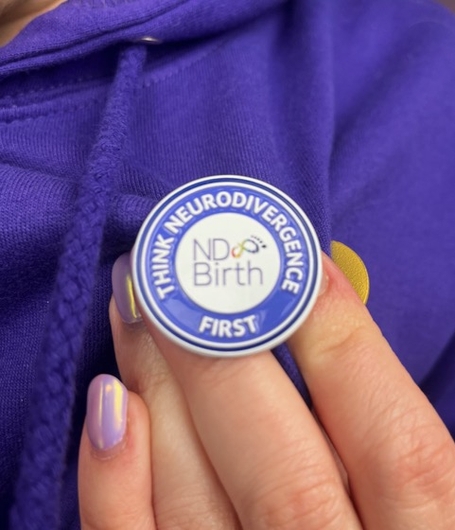
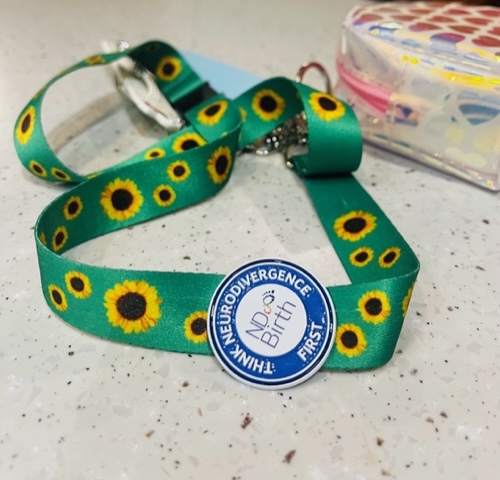
As part of this campaign, ND Birth is inviting maternity and perinatal professionals to wear a ‘Think Neurodivergence First’ pin on their lanyard. It is a small act with real significance. For a neurodivergent person walking into a scan, a midwife appointment, or a postnatal check, that visible signal says: ‘I am thinking about this’, and ‘You can talk to me’.
At the Maternal Mental Health Alliance, we know that feeling unseen, unsupported, or misjudged during the perinatal period is not simply unpleasant, but it is also clinically significant. Perinatal mental health conditions affect at least one in four women and birthing people in the UK. For neurodivergent individuals, the risks are compounded, and autistic people and those with ADHD are at approximately a 60% risk of experiencing postnatal depression, and an increased risk of postnatal anxiety (Andersson et al, 2023; Dorani et al, 2021; Hampton et al, 2022; Pohl et al, 2020).
Receiving care that is affirming rather than scrutinising, is a clinical necessity. The quality of those early interactions with perinatal services can shape a person’s willingness to seek support, their trust in professionals, and their experience of becoming a parent. Getting it wrong has consequences that ripple outwards and impact families immeasurably.
With huge thanks to Victoria for this piece, and for reminding us all why a neurodivergent-first lens matters so much in perinatal mental health.
Receive news and information on how your support is helping, our fundraising activities and ways you can get involved.