Posted By: Nikki Wilson
23rd April 2026
4 minute read


This is a guest blog written by Courtney Girvin from MMHA member, Aware NI.
The perinatal period is one of the most vulnerable times in a woman’s life. Almost 20,000 babies were born across Northern Ireland, and approximately 1,000 women and birthing people will experience a severe postnatal mental illness. Within the UK, suicide remains the leading cause of maternal death in the year following childbirth, highlighting the urgent need for accessible perinatal mental health services.
Despite this, Northern Ireland remains the only region in the UK without a local Mother and Baby Unit (MBU), a specialist inpatient service designed to support women and birthing people experiencing severe perinatal mental illness.
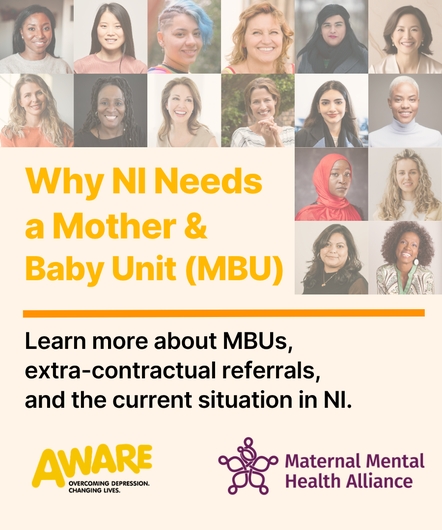
This blog will explain what Mother and Baby Units are, why they are critical for perinatal mental health care, the current situation in Northern Ireland, and how extra-contractual referrals are used to access specialist support outside the region.
Mother and Baby Units (MBUs) are highly specialist inpatient services for women and birthing people experiencing severe perinatal mental illness. This can include postpartum psychosis, severe depression and anxiety, and obsessive-compulsive disorder. In Northern Ireland, between 84 and 122 women each year will require hospital admission for severe postnatal mental illness.
MBUs are designed to keep mum and baby together while providing specialist perinatal mental health care. This is critical, as the first 1001 days of a child’s life play a vital role in their long-term emotional and developmental outcomes.
Without access to a local Mother and Baby Unit, women and birthing people across Northern Ireland are often admitted to general psychiatric wards. In many cases, this results in mothers being separated from their babies, which can disrupt early bonding and lead to lasting trauma.
General inpatient wards are not equipped to meet the needs of women and birthing people experiencing severe perinatal mental illness. Staff may not have specialist training in perinatal mental health, and wards often lack access to basic but essential facilities, including appropriate postnatal care items, private spaces for breastfeeding or expressing milk, and safe storage for expressed milk.
Women and birthing people in Northern Ireland deserve equal access to specialist perinatal mental health services, including Mother and Baby Units, in line with the rest of the UK.
Extra Contractual Referrals (ECRs) occur when a patient is referred outside their local NHS area to access specialist care. In the context of perinatal mental health services, this means that where there is no local Mother and Baby Unit available, women in Northern Ireland may be referred to one of the 22 MBUs across the UK.
For some, accessing a Mother and Baby Unit through an extra contractual referral can provide vital specialist support. However, this option is not suitable for everyone. Being admitted to a unit outside Northern Ireland can mean separation from family, friends and established support networks, adding an additional emotional strain during an already vulnerable time.
Despite this, extra contractual referrals can be life-changing. Ruth, living in Belfast and who experienced postpartum psychosis, was admitted to a Mother and Baby Unit in Scotland through extra contractual referral. There, she had access to a private room for herself and her baby, alongside specialist psychiatric and midwifery care. Reflecting on her experience, she shared: “it was about learning to be mothers while also recovering,” highlighting the importance of daily routines such as feeding, dressing and play.
While extra contractual referrals offer access to specialist perinatal mental health care, they are not a long-term solution for Northern Ireland. Increasing awareness of this pathway is important, but it also reinforces the need for a local Mother and Baby Unit so that women and birthing people can access care closer to home.
The need for a Mother and Baby Unit in Northern Ireland has been recognised for over a decade. In 2008, the Northern Ireland Assembly Health Committee, chaired at the time by Michelle O’Neill, visited a Mother and Baby Unit in Scotland and recommended that a similar specialist perinatal mental health service be established locally.
Despite this early recognition, progress has been slow. It was not until 2023 that the Department of Health announced plans for a dedicated Mother and Baby Unit at Belfast City Hospital, marking a significant step forward for perinatal mental health services in Northern Ireland.
More recently, Health Minister Mike Nesbitt confirmed that the business case for the unit has been completed, describing the development as “long, long overdue.” While this signals progress, women and birthing people in Northern Ireland still do not yet have access to a local Mother and Baby Unit.
The development of a Mother and Baby Unit in Northern Ireland is not just a service gap to be filled - it is a critical step towards ensuring that women and birthing people receive timely, appropriate, and compassionate care close to home. It also protects the early relationship between mother and baby, which is fundamental to long-term wellbeing.
Women and families in Northern Ireland deserve the same access to specialist perinatal mental health services as the rest of the UK. Delivering a local Mother and Baby Unit is essential to achieving that.
What is a Mother and Baby Unit?
A Mother and Baby Unit is a specialist inpatient mental health service for women and birthing people experiencing severe perinatal mental illness, where mothers can stay with their babies while receiving treatment.
Does Northern Ireland have a Mother and Baby Unit?
Northern Ireland does not yet have a local Mother and Baby Unit, although plans have been announced.
What happens if someone in Northern Ireland needs an MBU?
Some women and birthing may be referred to a Mother and Baby Unit elsewhere in the UK through an extra contractual referral.
Who are MBUs for?
MBUs support women and birthing experiencing severe mental illness during pregnancy or after birth, including postpartum psychosis, severe depression, anxiety, and OCD.
https://www.thedetail.tv/artic...
https://maternalmentalhealthal...
https://www.belfastlive.co.uk/...
Receive news and information on how your support is helping, our fundraising activities and ways you can get involved.